
We help citizens see the shared world clearly enough to judge it for themselves.
The Information Wheel is our editorial constitution. Every Polders story helps a citizen move from evidence to verification, context, genuine difference and a synthesis that remains open to inspection.
This page sets out the guidelines Polders.Media follows to analyse and create editorial material. It is written for editors, writers, researchers, partners and external contributors, and it can be taken away below as a PDF or HTML edition.
Five functions support one democratic capability: independent judgement.
The Wheel is not a content format. It is the test of whether a citizen has been given a healthy information environment.
Do I know what happened?
Original reporting supplies the primary evidence. Polders credits where public knowledge began and closes material reporting gaps only when necessary.
Can I trust the claims?
Verification tests evidence, provenance and consistency. We mark fact, allegation, inference, uncertainty and correction distinctly.
Do I understand what it means?
Context connects the event to history, institutions, comparison and consequence—without explaining away inconvenient facts.
Have I seen relevant difference?
Diversity of perspectives reveals credible alternative readings. Difference must be material, not decorative, and its divergence must be measured.
Can I form an informed judgement?
Synthesis shows consensus, disagreement, omission and remaining uncertainty together—while preserving the route back to every source.
One fixed sequence. Five distinct functions. No substitute for any missing segment.
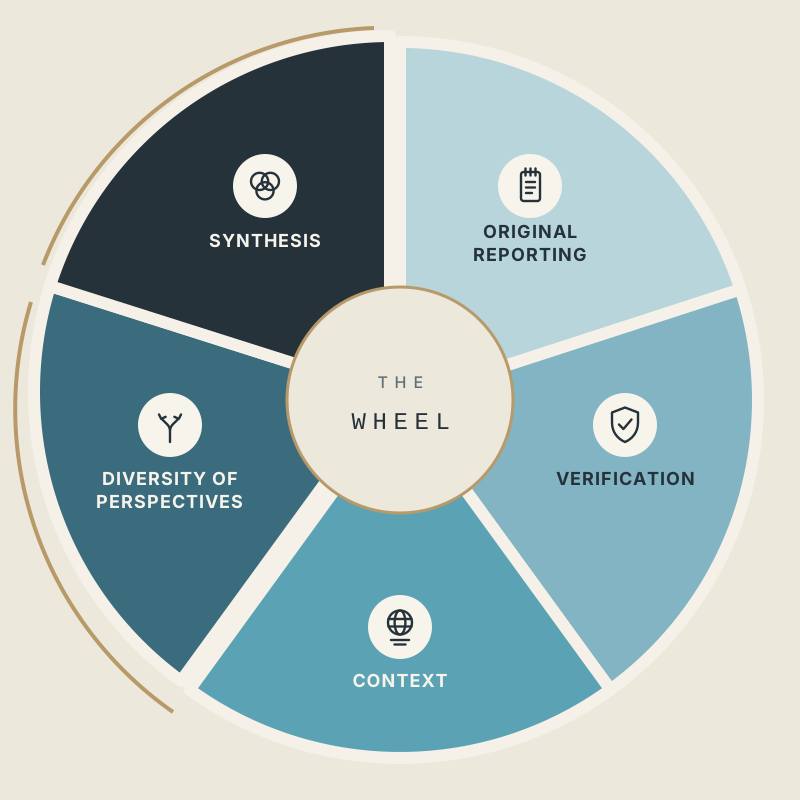
Read clockwise. Reporting establishes the record. Verification tests it. Context gives it meaning. Diverse perspectives reveal where credible accounts separate. Synthesis makes the whole landscape intelligible.
Plurality creates distance. Polders measures that divergence across evidence, emphasis, framing and omission, then preserves it in synthesis rather than sealing it over.
Each part of the Wheel answers a different citizen need.
No organisation owns the whole Wheel. A healthy information environment depends on distinct contributors—and on Polders making their combined record legible.

Original reporting
Produces primary evidence from the field. Polders identifies and credits originators; it commissions or adds reporting when the public record has a consequential gap.

Verification
Tests claims, provenance and consistency. We distinguish confirmed fact, contested claim, inference and unresolved uncertainty.

Context
Connects events to history, institutions, comparison and consequence. Context explains; it must not become a licence to dismiss inconvenient evidence.

Diversity of perspectives
Surfaces materially different, credible readings. Divergence measures evidence, emphasis, causal frame, language, proposed consequence and omission—not ideological worth.

Synthesis
Shows consensus, disagreement and missing information together. It preserves divergence, cites the landscape and never impersonates original journalism.
Every story travels around the Wheel—and returns agency to the citizen.
Establish the record
Find the originating journalism and primary documents. Credit discovery. Add reporting only where a consequential gap prevents understanding.
Test the claims
Check provenance and corroboration. Mark what is confirmed, contested, inferred or unresolved. Make corrections visible and cumulative.
Explain meaning and stakes
Connect history, institutions, comparisons and consequences. State why the issue matters to citizens and democratic life.
Compare before concluding
Select materially relevant, credible accounts. Measure divergence in evidence, emphasis, frame, language, remedy and omission.
Return judgement to the citizen
State the shared record, the genuine disagreement, the missing information and the responsible conclusion. Cite every synthesis claim at the point of use and name what evidence would change it.
A brief, comparison, analysis or long read may give the segments different weight. It may never conceal which parts are present, which are supplied by others and which remain missing.
No actor is scenery. Each enters with a role, evidence, interest and limit.
Citizens
Agents, witnesses and affected people—not a passive “audience.” The Wheel exists for their informed judgement and capacity to contest power.
Journalists & publications
Primary contributors to reporting and verification; collectively they also create plural perspective. Credit origin, compare fairly and retain distinct contributions.
Government & public bodies
Sources of records and decisions, but also claim-bearing actors. Their material can support reporting, verification and context; “official” never means self-validating.
Experts & researchers
Contributors to verification and context, not authority theatre. State relevant expertise, evidence base, uncertainty and conflicts.
Civil society & affected groups
Sources of evidence, experience and competing public values. They strengthen context and perspective when their inclusion changes understanding.
Polders
Custodian of comparison, divergence measurement and synthesis. We preserve sources and difference; we may fill reporting gaps but never replace the landscape.
Our register
Analytical, composed and lightly editorial. Precise verbs, named evidence, restrained conclusions. Explain complexity without performing complexity.
Our discipline
Evidence before rhetoric. Fact, inference and judgement remain distinct. Claims are never louder than their support; corrections remain visible.
What we refuse—and what must be true before publication.
We will not
Publish seamless synthesis without visible sources and reasoning.
Pretend every position has equal evidential support in the name of “balance.”
Reduce divergence to partisan conflict, outrage or a context-free bias score.
Treat an official account, expert title or majority view as self-validating.
Erase the journalism, documents or people from which public knowledge came.
Hide uncertainty, material omission, corrections or limits behind confident prose.
Use AI as an anonymous author, unexamined source or substitute for editorial responsibility.
Tell citizens what to think when our task is to help them judge.
Commissioning & publication check
Is the citizen’s question and democratic consequence clear?
Can the originating reporting and primary evidence be identified?
Are all major claims verified, qualified or explicitly unresolved?
Is there enough context to understand cause, history and consequence?
Are the relevant parties positioned by role, evidence, interest and limit?
Are missing or underrepresented perspectives named?
Is divergence described across evidence, framing, emphasis and omission?
Can every synthesis claim be traced back to its sources?
Are fact, inference and editorial judgement visibly distinct?
Does the ending return agency—and the limits of knowledge—to the citizen?
A Polders story succeeds when a citizen can see not only what to consider, but why it is credible, where accounts differ and how to reach an independent judgement.
Download the Editorial Brief
The framework is free to download in two volumes: the foundational framework and the operational handbook, both as print-ready A5 PDFs. As with the publications in our reading room, we ask for your name, organisation and email so we know who is reading. One form covers both volumes.
Information Governance for Editorial Organisations
Volume I, the foundational framework. The democratic purpose, Information Governance, the Information Wheel, the shared ecosystem and the path from constitution to standard.
Polders Editorial Standard
Volume II, the operational handbook. Publication statuses, the format matrix, workflow, roles and accountability, AI boundaries, risk and escalation, and the publication check.
Your details are used as described in the . For a briefing or collaboration on these guidelines, write to gvn@polders.news.